Showing posts with label Emirates. Show all posts

Qatar Airways has won the annual SkyTrax airline award for the best Economy Class in the world, which means a lot in these tough economic times when passengers are increasingly moving to the back of the plane from the front.


Qatar Airways recently revamped its Economy Class meal service using a more environment friendly, upmarket, appetising and stylish way.

Qatar Airways Chief Executive Officer Akbar clearly has his priorities well targeted, summing up his airline's approach

“Most airlines invest heavily in developing their premium cabins and, while we continue to do this, Qatar Airways strives to innovate in Economy Class ensuring our high standards are maintained and passenger expectations are exceeded worldwide.”
Etihad Airways won the prize for the best Business Class, narrowly beating Singapore Airlines, who won the prize for best First Class. Virgin Atlantic won the prize for best Premium Economy Class, a high in demand travel class nowadays

Cathay Pacific, Singapore Airlines, Asiana Airlines, Qatar Airways and Emirates won the top five spots for "Airline of the Year 2009" respectively.

View the full results here.

Share this article
If you liked this article please share it with your friends    Bookmark and Share
Digg Stumble Delicious Technorati Twitter Facebook Yahoo Buzz


| 0 comments ]
[Tags : , , , , , ]

Two deliveries of "first" of aircraft model occurred on March 27th.

Airbus delivered the first A330-300 to Finnair, out of an order for eight. Powered by General Electric CF6-80E1 engines, the new aircraft is in a two class configuration 42 Business, 229 Economy for a total seating for 271 passengers.

On the same day, Boeing delivered the first 777 Freighter to Emirates SkyCargo via Dubai Aerospace Enterprise (DAE). Coincidentally, Dubai Aerospace Enterprise Capital, the leasing arm of DAE, also has a total of eight 777 Freighters on order.

Images courtesy and copyright of Airbus and Boeing

Share this article
If you liked this article please share it with your friends    Bookmark and Share
Digg Stumble Delicious Technorati Twitter Facebook Yahoo Buzz


| 0 comments ]
[Tags : , , , , , , ]

Effective March 29th, Gulf Air is withdrawing its flights from Bahrain to Bangalore and to Hyderabad. No explanation has been provided by the airline, but I suspect that they have been crowded out by the far more aggressive Emirates Airlines.

Gulf Air flies a small Airbus A320 to Bangalore daily and a slightly larger A321 to Hyderabad four times a week, while Emirates flies three Boeing 777s/A330s daily to both cities.

Having overtaken European and ASEAN carriers, this is the first case of a fellow middle east airline feeling the pressure of the relentless expansion by Emirates across the Indian skies.

On the same date, March 29th Jet Airways will launch its Mumbai Kuwait service which complements their existing Kochi (Cochin) Kuwait service.

Mumbai-Kuwait: 9W 572 Dep 1900 hrs. Arr 2030 hrs.
Kuwait-Mumbai: 9W 571 Dep 2130 hrs. Arr 0400 hrs.

Obviously there is more traffic between Kochi and Kuwait, since even the Mumbai Kuwait service will offer convenient connections to the Mumbai Kochi services of Jet.

Share this article
If you liked this article please share it with your friends    Bookmark and Share
Digg Stumble Delicious Technorati Twitter Facebook Yahoo Buzz


| 0 comments ]
[Tags : , , , , ]

An Emirates Airlines Airbus A340-500, Emirates Airlines Airbus A340-500, registration A6-ERG performing flight EK407 from Melbourne, Victoria, Australia, to Dubai, United Arab Emirates, with 225 people on board, damaged and decommissioned the main runway at Melbourne airport while taking-off.

The aircraft ran off the runway 16 (length 3657 meters / 12,000 feet) around 22:30 local (12:30GMT) March 20, during its take-off run, struck its tail on the runway, and hit the runway end lights and the localizer antenna past the end of the runway 16.

The airplane climbed out safely, and tried to dump fuel over the ocean at Port Philip Bay but was forced to return to Melbourne for an immediate emergency landing when smoke started to fill the cabin.

The airplane was fully fuelled for the long non-stop flight to Dubai, and the heavily loaded aircraft landed hard on Melbourne's runway 34. She was able to taxi to the apron after being inspected by airport's emergency services.

Severe abrasions occurred to the tail skin and several access panels have been ripped off during the tail strike at take-off. The hard landing, un-avoidable due to the full fuel weight, has reportedly caused damage to the landing gear.

Melbourne airport authorities have confirmed that ILS runway 16 will need repairs and will not be available until Monday, March 23rd.

For full technical details of the accident including NOTAMs and METARs please visit Aviation Herald. Hat tip to Simon Hradecky who runs a great site keeping track of all the aviation incidents around the world.

Share this article
If you liked this article please share it with your friends    Bookmark and Share
Digg Stumble Delicious Technorati Twitter Facebook Yahoo Buzz


| 0 comments ]
[Tags : , , , , , ]

Emirates recently announced that it will commence services to Toronto and Bangkok with its Airbus A380 superjumbo from June 1st.

In order to do this Emirates will have to reposition two of its A380s from the current double-daily New York route.

Emirates representatives have confirmed this re-positioning. One aircraft will be deployed on the three times a week Dubai Toronto service, and one will be used for one of the double daily Dubai Bangkok service.

One of the double-daily flights currently operated by the A380 will be replaced by a Boeing B777-300ER on the Dubai-New York JFK route.

While this re-positioning is occurring, all is not well between Airbus and Emirates. German paper Der Spiegel reports that the airline has slammed Airbus for "defects" on the plane, which has grounded the behemoth aircraft nine times costing the airline over 500 flying hours.

Emirates has presented Airbus with a damning list of defects in the new A380 super-jumbo jet. The airline, which has ordered 58 of the aircraft, warns of a possible "loss of confidence" in the giant plane.
While both the airline and manufacturer are putting on a front on congeniality in public, in private storms are brewing over perceived shoddy work ethic at Airbus and its suppliers, by Emirates.

In a presentation in February, Emirates showed Airbus a 46 page presentation with included photographs of defects including singed power cables, partially torn-off sections of panelling and defective parts of thrust nozzles in the engines.

The other two operators of the Airbus A380 are Singapore Airlines and Qantas. They seem to be taking a softer line with Airbus, but Emirates has a lot more at stake with a 58 plane order which represents over 25 per cent of the total order book Airbus has on the aircraft.

Read the full article here.

Share this article
If you liked this article please share it with your friends    Bookmark and Share
Digg Stumble Delicious Technorati Twitter Facebook Yahoo Buzz


| 0 comments ]
[Tags : , , , , ]

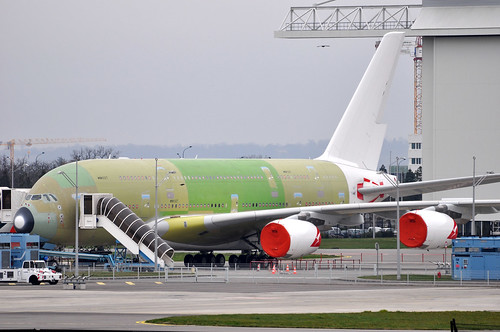
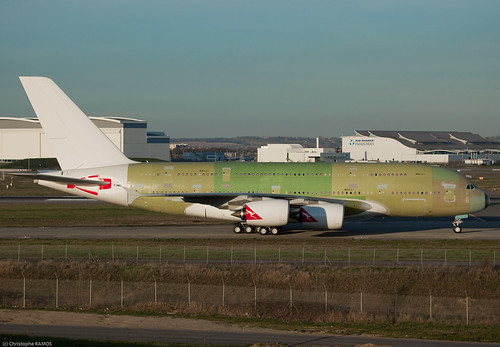
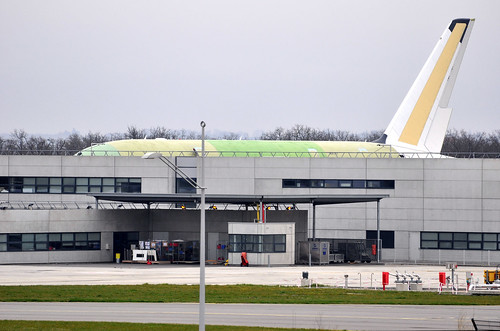
Some updates on the production progress of the Airbus A380 superjumbo, courtesy of the A380 production forum.

MSN027 (F-WWSY) the fifth for Qantas (VH-OQE Lawrence Hargrave) came out of the Final Assembly Line (FAL) hangers and made its taxi tests.


MSN029 (F-WWSA) the sixth for Qantas (VH-OQF Charles Kingsford Smith) has been outside since it came out of the FAL in mid February. While inside the FAL, MSN027 and MSN029 had their tails switched. MSN027's tail going on MSN029 and vice versa. During a hail storm last year there was damage to MSN027's tail. To keep the production schedule, the tails were switched and repairs carried out. You will observe the tail on MSN029 (originally MSN027 tail) has been marked in black in some areas.


MSN023 (F-WWST) sixth for Emirates A6-EDF has left the FAL and is now on the flight line. It will make its first engine and taxi runs in early to mid April and also expected to fly in April as well.

A380_MSN023_F-WWST_Emirates_MSN029_F-WWSA_sixth_Qantas
MSN017 for Emirates (A6-EDE) will be delivered on 24th April.

Photos 1, 3, 5 courtesy Flickr user A380spotter. Photo 2 courtesy Flickr user Christope Ramos. Photo 4 courtest PictAero user David Barrie. All copyrights rest with them.

Visit the Bangalore Aviation Flickr photo gallery.

Share this article
If you liked this article please share it with your friends    Bookmark and Share
Digg Stumble Delicious Technorati Twitter Facebook Yahoo Buzz


| 0 comments ]
[Tags : , , , , , ]

A380 MSN017
The 5th A380 for Emirates Airlines, A6-EDE, is on the flight line at Hamburg and expected to be delivered in April. Thanks to the folks at the Hamburg Airport forum, enjoy the picture. Given the slowdown at Singapore Airlines, there is some debate on whether the next A380 out will be MSN026 (Qantas' 4th A380 VH-QQD) or MSN019 (Singapore Airlines' 7th A380 9V-SKG). I suggest following the knowledgeable folks at the A380 production forum.


Airbus delivers 500th A321 MSN3814
Last Friday, Airbus achieved a milestone and delivered the 500th A321 to Air France, who coincidentally received the first A321 delivered in 1994. As of date, Airbus has sold more than 750 A321s to about 65 customers all around the world.

Philippe Durand of Air France (left) and Uwe Schunke, Director Contractual Acceptance at Airbus

Korean Air order for six Airbus A330-200 WV058
Last September, Airbus fired a shot across the bows of the Boeing 787 Dreamliner, when it announced a new longer range A330-200. Weight Variant (WV058) A330-200 has a 238 tonne MTOW (Maximum Take Off Weight) providing it a range of 7,200 nm, and thus allowing Airbus a product to take on the first batch of Boeing 787-8 Dreamliners, till the A350XWB came on line.

Korean Air (KAL) has placed a new firm order with Airbus for six more A330-200 aircraft for the WV058 variant. The 7,200 nm range allows the airline to connect its home base at Incheon to almost all continents in the world non-stop with the exception of South America. KAL will use these new aircraft for medium density non-stop routes to North America and Europe.

The aircraft will be in a three-class cabin layout, and is scheduled for delivery from 2010. The new order increases the total number of A330s ordered by Korean Air to 25, comprising 16 A330-300s and nine A330-200s.

One can speculate plenty, but this appears a preventive measure, and part of an on-going trend, due to the delivery delays on the 787, rather than a cancellation of KAL's 10 787-8 order. With significant vendor involvement in the 787, Korea will not risk economic repercussions a cancellation might bring.

It is possible that the ordered 10 787-8's will get converted to 787-9's, which are expected to commence delivery in 2013, and these will replace the existing KAL A330 fleet, but this is idle speculation for now.

Share this article
If you liked this article please share it with your friends    Bookmark and Share
Digg Stumble Delicious Technorati Twitter Facebook Yahoo Buzz


| 0 comments ]
[Tags : ]

The natural tendency during a recession is to batten down the hatches, freeze all spending, and ride out the storm. There is also a school of thought which advocates increasing investments and advertising spend during a recession to increase market share, when customers are looking to change in an effort to obtain better value for their spend.


Quite evidently, Sheikh Ahmed bin Saeed Al-Maktoum, Chairman and Chief Executive, Emirates Airline is in the latter.

In early January I had written about the phenomenal 400% expansion of Emirates Airline in India, now it appears that Emirates is going for the jugular of its competitors across the globe. At a time when all airlines are cutting back and removing capacity, Emirates recently unveiled plans to grow the number of flights across its network by 14% in 2009. Compare this to the 11% reduction in capacity announced by another world famous and recession beater - Singapore Airlines, just three days ago.

Established in October 1985 with leased aircraft operating flights to Karachi, Pakistan and Mumbai, India, Emirates Airline today directly serves 101 cities in 61 countries. In October 2008, the Emirates dedicated Terminal 3 at Dubai International Airport opened. With a total built-up area of 515,000 sq metres and the capability of handling 43 million passengers annually, the 10-storey concourse was specifically designed with Emirates’ future growth plans in mind.

In 2008, 22 million Emirates passengers passed through Dubai International Airport, an 11% increase on 2007.

This year, Emirates will add 18 new aircraft to its fleet, increasing seating capacity by 14% and enabling it to start new routes as well as increase frequencies on many existing routes. It will also expand cargo capacity by 17%.

The additional frequencies will afford passengers a greater choice of flights, more frequent connections with their target markets and shorter, more convenient connection times.

Emirates already has an all wide-body fleet of 129 aircraft. By the end of the 2008-09 financial year, ending March 31, the fleet will increase to 132, including four superjumbo Airbus A380s. In fiscal 2009-10, the carrier will add a further seven A380s along with 10 Boeing 777-300ERs, one 777-200LR and one Boeing 777F freighter.

Sheikh Ahmed bin Saeed Al-Maktoum, Chairman and Chief Executive, Emirates Airline and Group, recently said

“The next year is not going to be an easy ride for the airline industry. Emirates has prepared the best we can for the challenges we foresee, but we also see it as a time of opportunity. 2009, with our significant capacity increase, will be a year of consolidation for us, with fewer new routes launched than in previous years.

“Instead, we will concentrate on strengthening our presence on routes where there is a greater demand from our customers. All of our new capacity will be deployed in markets where we see growth potential, particularly Africa and the Middle East.”
Africa and the Middle East are Emirates’ fastest growing markets, recording 17% and 6% growth respectively in the last 12 months.

Emirates recently added a second daily flight to Lagos. It will also introduce services from Dubai to Durban, South Africa on 1st October 2009. The route will be served by a two-class, 278-seat Airbus A330-200 which can also carry up to 14 tonnes of cargo into the port city.

Last month, Emirates announced a vast Middle East expansion plan taking the number of seats in the region to 50,000 on 180 flights a week. Additional services to Amman, Riyadh, Jeddah, Kuwait and Damascus were started recently.

Emirates has added 32 weekly flights to its existing Indian services since November, and now operates 163 weekly flights into 10 Indian gateway cities, almost 400% more than it nearest foreign competitor.

As new aircraft come online, both of Emirates' newest routes, Los Angeles and San Francisco, launched in October and December and operated by its luxurious Boeing 777-200LRs, will go from thrice weekly to dailies from May. The extra services will add more than 2,000 seats a week to the current 1,600 seats, between the US west coast and Dubai.

Emirates' strategy is demonstrated very well in Bangalore. The west coast flights enabled Emirates to compete head-on with all the European (British Airways, Air France, Lufthansa) and Asian (Singapore Airlines, Thai Airways, Dragon Air/Cathay Pacific) carriers, for the technology sector dominated traffic of Bangalore, and their need to fly to North America and Europe. From one flight Emirates ramped up to three flights a day. Two of the airline's current three daily flights are going full, and third is also at very respectable passenger load factors. During this time, almost all the other carriers, cut back on flights, frequencies, and/or aircraft capacity.

On 1st February, Emirates became the first carrier to operate commercial superjumbo Airbus A380 flights into New Zealand with the launch of its Dubai-Sydney-Auckland service. There is increased capacity to Australia with additional daily flights to Brisbane and Melbourne, taking the total number of flights a week to 63 effective 1st February. From 1st May, a third daily service to Sydney operated by its 489-seat Airbus A380 three times a week will be added, in full competition to the A380s operated by Australia's Qantas and Singapore Airlines.

Plans are also afoot to deploy the A380 superjumbos on Dubai–Seoul and Dubai–Singapore services in November and December respectively.

The first A380 flight between Dubai and Seoul’s Incheon International Airport will depart in November, while the Singapore service will start in December and initially run four times a week.

In Europe, Emirates has already embarked on an expansion programme. In recent months it has commenced double daily flights into Milan, increased Istanbul services to 11 flights a week, increased services on the Larnaca-Malta route to seven times weekly and Nice flights to five times weekly. Second daily services into Moscow and Athens are also planned for March.

Emirates has been recording an annual growth rate of 20 per cent over the last five years. In 2007, with the launch of its Dubai–Sao Paulo service, Emirates became the first, and only airline to fly to six continents non-stop from a single hub.

With the addition of more than 8,635 seats and around 600 tonnes of cargo capacity added to its fleet, Emirates is showing no signs of slowing down, on the contrary, competitors better watch out.

Share this article
If you liked this article please share it with your friends    Bookmark and Share
Digg Stumble Delicious Technorati Twitter Facebook Yahoo Buzz


| 0 comments ]
[Tags : , , , ]

From the Summer 2009 schedule which commences end March, Air France will suspend its thrice weekly flight between Paris Charles De Gaulle and Chennai Anna International, and withdraw from Chennai.

I strongly suspect this move is partly as a result of the relentless capacity expansion by Emirates Airlines across India.

With its non-stop connectivity to both the coasts of the United States, and Europe from Dubai, Emirates has been steadily poaching passengers from all other airlines across India. At Chennai, Emirates, will be increasing to 19 flights a week in February, and to thrice daily by end of the year.

In the recent past British Airways has withdrawn from Kolkata, KLM from Hyderabad, and Austrian Airlines from Mumbai. Alitalia completely withdrew, but then, those are due to its bankruptcy.

Share this article
If you liked this article please share it with your friends    Bookmark and Share
Digg Stumble Delicious Technorati Twitter Facebook Yahoo Buzz


| 0 comments ]
[Tags : , , ]

Dubai based Emirates Airline will commence operations of its Airbus A380 superjumbo aircraft to Seoul's Incheon International Airport in November 2009.

Emirates currently operates daily flights to Seoul using a Boeing 777.

Trade ties between South Korea and Dubai have been growing steadily, and major Korean corporations are active in the Dubai business arena. The Korean government is also positioning award winning Incheon airport as a major hub.

The new service is also timed to coincide with Visit Korea Year in 2010, aimed to promote South Korea as a destination for international tourism.

Seoul will be the fifth destination for the Emirates A380 after New York, London, Sydney and Auckland.

Emirates A380s has a state of the art cabin offering. It includes on-board shower spas in the private suites First Class cabin, a new generation of intelligent seating and flat-beds in Business Class, mood-lighting, and an in-flight entertainment system featuring over 1000 channels of entertainment

Share this article
If you liked this article please share it with your friends    Bookmark and Share
Digg Stumble Delicious Technorati Twitter Facebook Yahoo Buzz


| 0 comments ]
[Tags : , , , , , ]

A mere 16 months after launching services with the Airbus A380 superjumbo, Singapore Airlines is expecting to fly its one millionth A380 customer in February 2009.

Singapore Airlines was the first airline in the world to fly the Airbus A380 super-jumbo, the world’s largest passenger aircraft, when it began commercial services between Singapore and Sydney in October 2007. The Airline is expecting to welcome its first millionth customer on-board the A380 within the next six weeks, and is planning to surprise the customer and other customers on the flight with a series of goodies, and what a set of goodies it will be.......

The lucky millionth customer will be greeted with the news upon check-in and a special package. Beyond the enhanced in-flight experience, the winner will get to enjoy a host of prizes at the destination, including a three-night stay at a luxury hotel and a chauffeur-driven limousine ride to the hotel, experiences at top-class restaurants as well as a series of other goodies to take away.

The millionth passenger's fellow travellers will also enjoy the occasion with special Singapore Airlines giveaways, and champagne in all three classes. I am confused by this. First and business class passengers are served champagne on-board already. First Class passengers are served their choice of Krug or Dom Perignon, no less.

Singapore Airlines has six aircraft in fleet now, flying daily between Singapore and Sydney, Singapore and Tokyo, and twice daily between Singapore and London. Since its launch, the A380 has clocked over 20,000 flying hours on more than 2000 commercial flights.

In addition to Singapore Airlines, Emirates has four, and Qantas three. With Qantas launching London Heathrow service very soon, the airport will have the distinction of receiving A380 from all the three A380 operators.

Share this article
If you liked this article please share it with your friends    Bookmark and Share
Digg Stumble Delicious Technorati Twitter Facebook Yahoo Buzz


Jet Airways procured ten ultra-luxuriously appointed Boeing 777-300ERs for its ambitious international expansion. It even won awards for its international first class, featuring private suites.

Now those plans are in tatters, and Jet has abandoned its international ambitions, at least for the foreseeable future. Recently TravelBizMonitor reported

Jet Airways, has dropped its expansion plan, especially plans of expanding overseas informed a top official source of the airline. “We have dropped plans for overseas expansion for the time being. Now our focus will be on consolidation. In the domestic markets also, we are reducing capacity. We are also going slow on the acquisition of new aircraft,” said the source. As part of their cost-cutting plan, Jet Airways may also resort to leasing out their fleet.
Jet Airways/Turkish THY/Gulf Air
Boeing 777-300ER seat map.

The "may lease out its fleet" is already an "is leasing out its fleet". Turkish Airlines THY is already reaping the benefit of the three 777s it has leased from Jet. THY has been enjoying unprecedented success with its 777, and a possible fourth Jet 777 is rumoured expected to join THY soon.

Now, Business Traveller and Air Transport Intelligence are reporting, Bahrain based, Gulf Air is expected to lease four Jet Airways Boeing 777-300ERs, which it will introduce on routes including London Heathrow from March.

Gulf Air chief executive Bjorn Naf has said the carrier would take all four 312-seat 777s this year, and lease them for around three years. While Naf declined to identify the source of the aircraft, it is certainly Jet Airways. Gulf Air has already leased two Airbus A330s from Jet Airways, which has also been actively seeking to lease out its 777-300ERs to generate desperately needed cash.

The 777s would potentially serve as a replacement for a few of Gulf Air's current A340-300s.

It is unclear whether the aircraft will be "wet leased" i.e. along with the crew, as in the case of Turkish THY, or a "dry" aircraft only lease.

Jet Airways has seven Boeing 777-300ERs and nine Airbus A330-200s left in its fleet after the first round of leases to Gulf and THY. After this Gulf Air deal, it will have only three 777s left in its fleet. That will surely require some more route and capacity rationalisation by Jet on its existing international operations. Talks with Oman Air for lease of Jet Airways aircraft, are also expected to fructify very soon, and passengers in India can expect to bid adieu to Jet Airways from the international skies.

In a repeat of THY, Gulf Air’s premium passengers are in for a treat, as Jet’s product includes fully flat beds in business class and private suites in first. (View a photo gallery of the premium classes)

After years of watching its rivals Emirates, Etihad and Qatar, expand their fleets with superior cabin aircraft, which forced a further contraction at Gulf Air, the airline will now be able to mount a serious challenge.

In addition to the Bahrain - London Heathrow route, Gulf Air is considering using the 777s on Bahrain - Bangkok and Bahrain - Kuala Lumpur routes. The 777s will also afford Gulf Air the possibility of serving the US east coast.

Incidentally, today is Makar Sankranti, a festival that signifies the beginning of the harvest season for the farmers of Indian Sub-Continent, and the only Hindu festival celebrated by the solar calendar. All other festivals are by the lunar calendar. Happy Sankranti to all Bangalore Aviation readers.

Share this article
If you liked this article please share it with your friends    Bookmark and Share
Digg Stumble Delicious Technorati Twitter Facebook Yahoo Buzz


| 0 comments ]
[Tags : , , , ]

On 16 October 2008, Emirates Airlines, moved all operations at Dubai International Airport to Terminal 3. Terminal 3 is over 1,500,000 m2 (370 acres) in size, the single largest terminal building in the world, and is dedicated exclusively to Emirates Airlines.

The move demonstrated the meteoric rise of the airline since its inception on May 25, 1985 with just two leased Airbus A300 and one Boeing 737-300 aircraft, to the titan of the airline industry, it has become today.

Emirates has recorded a profit every year, except in it's second, and growth has never fallen below 20% a year. In its first 11 years, it doubled in size every 3.5 years, and has every four years since. The Emirates Group announced a net profits of Dhs5 billion (US$1.37 billion) for the financial year ended 31 March 2008, a 62% increase over the previous year. Business lore has it, that Emirates airline's turnover is almost 20 per cent of Dubai's GDP.

Credit to Emirates' business model, which has led to their phenomenal success. Despite being considered one of the best providers of services, Emirates practices a lean workforce policy, and simple organisational structure, which is comparable to low-cost carriers, instead of the complex and bloated workforces at most legacy and full service airlines. Like it's super-profitable, high service level, compatriot, Singapore Airlines, Emirates operates an "all wide body" fleet, which results in lower costs, while allowing Emirates to earn additional revenue utilising cargo capacity.

The low overheads, coupled with a no income tax regime at Dubai, gives it operating costs that is the envy of the airline world. Industry analysts believe that Emirates has a cash cost per seat basis second only to Ryanair. The Dubai airport is another ace in the hole for Emirates. The airport's low operating costs, round the clock operations, and geographic location, give Emirates a significant competitive advantage.

India has always been on the forefront of Emirates' radar screen. India has always been a "west bound" country, with maximum traffic to North America (USA being India's biggest trading partner), Europe, and Middle East.

Emirates' first flights were to Karachi in Pakistan and Mumbai, India. Utilising the geographic position of it's home base Dubai, Emirates has been steadily capturing the traffic from South Asia to North America, allowing passengers to bypass the traditional hubs of London Heathrow, Frankfurt, and Paris Charles De Gaulle; the home bases of British Airways, Lufthansa, and Air France, with a transit stop in beautiful Dubai airport instead. Similarly, Emirates competes with British Airways, Qantas, Singapore Airlines, and other airlines on the lucrative London to Sydney "Kangaroo Run".

The imposition of mandatory transit visas by most European countries, on South Asians does not help the cause of their airlines, since South Asian get automatic transit visas in Dubai. The fabulous duty shopping and bargains galore, add to the passenger draw.

In November 2008, Emirates, already holding the position as the number one foreign airline to India, announced that it would add another 31 weekly flights to India by early 2009, taking it's total to a staggering 163 flights per week from 10 cities in India.

This at a time, when other foreign airlines were cutting back their services to India, and India's airline industry struggling to overcome the economic malaise of theirs and the Government's of India making.

Emirates has already muscled it's way in, at the traditional strongholds of traditional, major foreign airlines, British Airways, Lufthansa, and Singapore Airlines; Mumbai, Delhi, Chennai, Kolkata, and Bangalore. Now it is beginning to crowd them out with its capacity.

Just as an example, Chennai, the traditional stronghold of Singapore Airlines with 11 flights a week. In 2006, Emirates had 4 flights a week. In less than 2 years, today, it has 19 flights a week, which will become triple-daily i.e. 21 flights a week from Winter 2009. In the mean time, Singapore Airlines has cut back its flights to 9 a week, and even that looks unsure.

Emirates, has also announced plans of adding another 19 flights by the Winter 2009 schedule. At 182 flights, keeping in mind, the speed with which Indian carriers Jet Airways, Kingfisher Airlines, and Air India, are withdrawing their international services, Emirates stands become the largest airline operating internationally, in India.

Some will compare this expansion to capacity dumping, since only Mumbai, New Delhi, and maybe, Bangalore have the ability to absorb the seats and cargo space offered. Below is a brief review of Emirates plans for each of its Indian gateways. It is important to keep in mind, Emirates has an "all wide body" fleet, and operates only Boeing 777s and A330s to India.

Ahmedabad*
Emirates will increase its existing 8 weekly flights to a double daily i.e. 14 flights a week in it's Winter 2009 schedule which commences December 1, 2009.

Singapore Airlines is going to stay at its 3 weekly flights for the foreseeable future.

Bangalore
Emirates will operate 20 weekly flights. Cargo capacity will increase to 340 tonnes.

Jet Airways is withdrawing its Brussels flight, Singapore Airlines has reduced frequency from 10 weekly flights to 7, Kingfisher is struggling to fill seats on it's daily London Heathrow flight, as are Lufthansa, Air France, Etihad, Qatar Airways, Malaysia Airlines, Thai Airways, and British Airways. Air India operates one puny Airbus A320 with international transit connectivity at Mumbai, and is barely clinging on.

Chennai
By February 2009 weekly 19 flights. Due to increase to triple-dailies from Winter 2009.

Singapore Airlines has cut capacity from 11 weekly flights to 9. Malaysian and Thai Airways are fighting an uphill battle. British Airways has reduced frequency from 6 flights a week to 4, Air France is experiencing pressure and is operating only thrice a week. Lufthansa reduced it's aircraft size from a Boeing 747-400 to an Airbus A340-600 now down to a Airbus A340-300. Only Sri Lankan airlines, in which Emirates has a stake, is performing acceptably.

Kochi*
Currently Emirates operates 12 flights per week, Emirates will add another two flights in February 2009 taking the total to 14 flights a week.

Competition ? What is that ?

Kolkata
Current Emirates operates a daily flight which will be upgraded to 11 flights a week in Winter 2009.

British Airways has announced withdrawal from Kolkata, and Lufthansa has reduced frequency to thrice a week.

Kozhikode* (Calicut)
From the existing 6 flights a week Emirates will increase to 11 weekly flights.

Hyderabad
Emirates will serve the city with a triple-daily operations by February 2009.

KLM is discontinuing operations. Lufthansa has already reduced frequency from a daily flight to 5 flights a week. British Airways just commenced with 5 flights a week, but it remains to be seen how the operations holds up in the future.

Mumbai
Effective February 1, Emirates will serve Mumbai with a fifth-daily operation i.e. 35 flights a week, providing the city with a service almost every five hours. Cargo capacity on the route will increase to 641 tonnes per week.

Air India and Jet Airways are trimming their European, and US services. Only time will tell, how successful Kingfisher's service to Heathrow, due to commence on January 5, 2009, will be.

New Delhi
India's capital which was initially served by 18 weekly flights will have a total weekly frequency of 25 flights per week post expansion. Weekly cargo capacity will increase to 389 tonnes.

Air India and Jet Airways are trimming their European, and US services.

Thiruvananthapuram* (Trivandrum)
From the current 8 flights a week, Emirates will ramp up to 10 flights a week, and then up to 12 flights a week in Winter 2009.

*Tier II cities. In these cities the Emirates' capacity build-up appears to be pre-emptive in nature, to establish a base and prevent other airlines from entering.

Emirates' Chairman Sheikh Ahmed bin Saeed Al Maktoum, Vice Chairman Maurice Flanagan, and President Tim Clark have built a formidable competitor. With it's new non-stop flights to San Francisco, Emirates has breached the ultimate barrier, now offering a one-stop connection between the Silicon Valley (SFO) and Silicon Plateau (BLR). Their march will continue this relentless pace.

While competition is good, and I am ardent propent, the leadership in India has to become pro-active lest Emirates crowds out all other carriers from India, at which point the country will be at the mercy of this giant. Politicians in India need to start pushing Indian airlines to start operating internationally. They should get out of the rut and let any Indian carrier fly internationally. In parallel they will have to twist the arms of British Airways, Lufthansa, Air France, and other legacy European carriers, to obtain favourable slots for Air India and other Indian carriers at London Heathrow, Frankfurt, and Paris Charles De Gaulle.

Share this article
If you liked this article please share it with your friends    Bookmark and Share
Digg Stumble Delicious Technorati Twitter Facebook Yahoo Buzz


| 0 comments ]
[Tags : , , , ]

Airbus SAS today handed over its 11th A380 superjumbo to Qantas Airways Ltd. of Australia.

Airframe serial number MSN022 was registered VH-OQC and christened Paul McGinness.

The plane was the third A380 for Qantas this year, Airbus spokesman Stefan Schaffrath said in an interview to Bloomberg.

The first two VH-OQA (Nancy-Bird Walton) and VH-OQB (Hudson Fysh) have been operating between Melbourne and Sydney and Los Angeles. Qantas is expected to deploy Paul McGinness on the "Kangaroo Run" between Sydney and London, starting in January 2009.

With just four days left in 2008, Airbus, the world’s largest maker of commercial aircraft, is scrambling to make one more delivery, in order to reach its goal of 12 deliveries this year.

That aircraft is expected to be delivered to Emirates, its largest customer for the A380, by Dec. 31, Schaffrath said.

Five A380's are already in operation with launch customer Singapore Airlines, and three with Emirates.

Share this article
If you liked this article please share it with your friends    Bookmark and Share
Digg Stumble Delicious Technorati Twitter Facebook Yahoo Buzz


| 0 comments ]
[Tags : , , , ]

Jet Airways and Emirates Airline, have today announced their partnership plans spanning a reciprocal frequent flyer arrangement and unilateral code share agreement.

Effective December 15, 2008, the two airlines will launch a reciprocal frequent flyer arrangement whereby members of Jet Airways' JetPrivilege, India's largest frequent flyer programme, may earn and redeem miles across Emirates' rapidly-expanding international network, with the exception of flights between India and Dubai. Members of Emirates' Skywards programme may also earn and redeem miles on all Jet Airways flights operating within India.

The same day, Emirates will also commence a unilateral code share on Jet Airways' daily flights from Mumbai and New Delhi to and from Dubai, offering passengers enhanced connectivity and a range of services between India and Dubai.

Jet Airways operates daily services on the Mumbai/New Delhi-Dubai sectors with it's Airbus A330-200 and Boeing B737-800 aircraft respectively, with a two-class configuration: Première (Business) and Economy. Jet Airways' flights on these sectors will be identified with its '9W' code as well as with the Emirates 'EK' code.

According to Mr. Wolfgang Prock Schauer, Chief Executive Officer, Jet Airways: "Dubai is an important market for Jet Airways and there is significant demand from our customers to travel to and beyond Dubai. We are delighted to be able to get this exciting, new agreement up and running quickly for the benefit of our customers. The frequent flyer partnership with Emirates, particularly, is a mutually beneficial one, enabling JetPrivilege members to tap into Emirates' impressive international network while earning and redeeming frequent flyer miles, and vice-versa vis-à-vis Jet Airways' unmatched pan-India domestic network."

Mr. Salem Obaidalla, Emirates' Senior Vice President Commercial Operations, West Asia, Indian Ocean and Africa stated: "The agreements between Emirates and Jet represent a significant step forward in strengthening the relationship between our two airlines and between long-standing partners, India and the UAE. The pact will enable us to offer passengers enhanced flexibility and at the same time it will boost trade and commerce between the two countries."

Currently, Jet Airways also has code share agreements with Air Canada, American Airlines, ANA, Brussels Airlines, Etihad, Qantas and JetLite.

Share this article
If you liked this article please share it with your friends    Bookmark and Share
Digg Stumble Delicious Technorati Twitter Facebook Yahoo Buzz


| 0 comments ]
[Tags : , ]

While we passengers spend tons of money on noise reduction headphones, and drive cabin crews silly with our umpteen requests for earplugs, weary Emirates Airbus A380 pilots are complaining that they cannot sleep in their crew-rest area in the aft main cabin because the aircraft is too quiet!!!

The pilots claim that the lack of engine noise in the A380's cabin means they are constantly disturbed by cabin sounds, such as crying babies, toilets flushing and cabin crew call bells.

Emirates pilots say, on other aircraft, the noise of the engines drown out the cabin noises. On the A380, even with the pilots sleeping with earplugs the cabin noise goes right through them. I wonder who their earplug vendor is. Earplugs are used by flight line personnel to drown out the engine noise from the outside, which is LOUD!!!

The Dubai-based carrier has asked Airbus for a solution that does not involve substantially adding weight. This eliminates the possibility of adding insulation to the walls of the rest area.

It appers Airbus has "exceeded" on its noise performance on the airline's Engine Alliance GP7200-powered A380s. One option could be installing lightweight noise generators.

Emirates has not opted for the standard Airbus option of locating the pilots' rest compartment behind the cockpit, as it would have compromised the design of the airline's upper deck first-class cabin. This adds to the pilots' problem as passengers mistake the rest area for a lavatory, and repeatedly pull the door handle. Emirates is the only A380 airline till date to have situated the crew-rest areas at the rear of the main deck. The alternate standard Airbus option of locating the pilots compartment in the cargo hold was rejected as "claustrophobic".

What do you think ? As usual comments are requested and welcomed.

Share this article
If you liked this article please share it with your friends    Bookmark and Share
Digg Stumble Delicious Technorati Twitter Facebook Yahoo Buzz


The turmoil in the Indian airline industry during the month of October has produced results that can be, only mildly described as, significant. In just four weeks, castles built over the last four or more years, have come crashing down.

By the end of 2008, the Indian airline industry which accounts for less than 2% of the global airline market, will contribute about $2 billion, or over 33%, of the total global losses. This dire, lop-sided situation, which can be attributed to only primary factor – gross imbalance. It is ironic, that the demand – supply imbalance in the Indian airline industry, is resulting in this imbalance between market share and losses share.

How did the situation become so dire?

Over the last 4 years, the Indian airline industry has created this imbalance thanks to rampant and blind expansion. It was all on auto-pilot, thanks to low fuel prices and a robust economy.

In 2008, along came the “perfect storm” and the reality struck home. Skyrocketing fuel prices since late 2007, married to a populist fuel pricing policy by the central and state governments in India which grossly overtaxed aviation turbine fuel (ATF), and sent the already high fuel prices in to the stratosphere, followed by a slowing economy thanks to the global financial credit crises and subsequent meltdown of demand, and uncontrolled costs.

Capt. G.R. Gopinath’s Air Deccan believed in bring airlines to the masses. To expand customer base Air Deccan expanded in to the smallest of cities, and given that, India is an extremely price sensitive country, offered fares that were at par with, or just marginally above, that of the Indian Railways, known to be one of the most economical railways in the world.

Along with with Air Deccan (now Kingfisher Red), low cost carriers (LCCs) Air Sahara (now JetLite), SpiceJet, IndiGo, and GoAir commenced. India seemed destined for low cost paradise, as even full service carriers, Indian Airlines (now Air India), Jet Airways, and Kingfisher Airlines, scrambled to develop low cost fare models of their own.

Thanks to the unbridled expansion, HR costs went in to orbit. From expatriate flight crews to the ground handlers, people were at a premium, and airlines paid, and paid way to well.

Another problem is, India does not have adequate full service airports, let alone, separate low cost airports like Europe and North America.

At all major airports across the country the skies became heavily congested, and it was not uncommon to hear an announcement from the Captain “Ladies and Gentlemen, welcome to Delhi. We are 25th in line for landing, and should land 2 hours from now”. This on a 1.5 hour flight.

The higher costs of full service airports, these delays, and systemic inefficiencies eroded the advantage LCCs in Europe and North America enjoy, i.e., making 9+ flights per day per aircraft, compared to 6 or less in India, and only added to the operating cost burden on all airlines, particularly the LCCs.

As global fuel prices rose, thanks to the fuel taxation policy in India, which makes ATF about 70% costlier than global standards, the impact on airlines was even more severe.

The airlines began to bleed profusely. Unable to sustain, airlines have been raising their prices over the last year, in some non-metro routes, by over 100%. The price sensitive Indian market, particularly in Tier II cities began to slow down.

In parallel, along came the economic slowdown. Demand slowed, and passengers across the board began tightening their belts. The bottom fell out of the market, as passengers shifted from the skies back to rail and bus. At the same time, new airports at Hyderabad and Bangalore were commissioned in the first half of 2008, these airports are far away from the city, and the long and costly commute, along with the rising air fares, totally erased demand in the regional routes, the demand-strength on which LCCs had based their massive expansion plans.

Domestic traffic has contracted over the last four months, declining by as much as 19% in Sep-08. Growth has fallen from 33%+ to over -20% within the span of just six months.

Indian domestic passenger numbers and passenger numbers growth: Jan-07 to Sep-08

Source: Centre for Asia Pacific Aviation & Ministry of Civil Aviation

In desperation, airlines have been resorting to steps, hitherto unthinkable, to stop their bleeding and cash burn.

To bolster yields per flight, airlines have cut capacity by 17% in the six months Apr to Sep 2008, and the further increase in prices have had even more impact on demand. Jet and Kingfisher entered in to an alliance, which left the jaws of most Indians agape on the floor, given the severe competition between them. Staff, including precious flight crew, started getting the axe. CEOs of three airlines are no longer there. Despite a 20%+ reduction in fuel prices (thanks to taxation cuts and falling crude prices), no fare reductions are being passed on to the passenger. The massive fleet expansions have been put on hold. Aircraft deliveries are being delayed. Aircraft already produced are being sold off to other global airlines. Aircraft in the fleet are being returned back. Disagreements and litigations will ensue, but the airlines have no choice. Their backs are against the wall.

The reduction in fuel prices will provide short term relief, but the outstanding fuel bills of the airlines are gigantic. Capacity reduction will have its impact only if properly rationalised with demand.

While, domestic demand crashed through the floor, the one bright spot was international traffic growth, which has remained consistently robust at 10% year-on-year for the first half of FY 2008-09. However, as the global economic slowdown has started taking its toll on international travel, many carriers, such as Singapore Airlines, Finnair, Austrian, British Airways, and KLM have announced capacity cuts and withdrawal of service. At the same time, with the Middle East being a robust market, Gulf carriers continue to grow. Emirates has become the largest foreign carrier in India and will aggressively expand from 132 to 163 weekly services over the next six months.

I am reminded of the Chinese saying “may you live in interesting times”. The rest of 2008 and whole of 2009 is going to be very interesting indeed. The medium term growth for the Indian airline industry is bright, but only for those who survive.

Kapil Kaul, CEO, Indian Subcontinent & Middle East, The Centre for Asia Pacific Aviation, gives us a look behind the scenes…

Jet-Kingfisher alliance - the unthinkable happens

The Jet Airways-Kingfisher alliance, which although unthinkable just a few weeks ago, is a reflection of the current fragile state of the market. The primary objective of this arrangement is to bring together the two largest players in the market, with overlapping networks, to reduce capacity and align it with demand, whilst at the same time being in a position to influence fares. At this stage, it would appear that this alliance will lead to extensive engagement and integration between the two carriers.

Key elements of the alliance will include code-sharing; interline and special prorate agreements; network rationalisation; joint fuel management; common ground handling; GDS integration; frequent flyer reciprocity and human resource sharing.

The alliance is yet to take-off in any meaningful way, to date there have been some initial meetings, but it is too soon to expect any concrete steps. The initial focus will be on network, commercial and revenue management issues. Both carriers are hoping that a reduction in capacity, optimisation of their respective networks, higher yields and lower fuel prices, together with the generally strong demand in the third quarter, should reduce losses. The future of the alliance depends on both carriers seeing equal and measurable improvements in performance.

Jet Airways restructuring

Jet Airways is similarly restructuring its domestic and international operations. Jet has reduced its capacity in H1 2008/09 by 13%. The combined seat production of Jet and JetLite has declined from around 56,000 daily seats in April 2008 to 50,000 in Sep-08.

Jet is actively pursuing a cost reduction strategy - staff rightsizing is a key element of this and has been implemented actively at JetLite. The recent attempt to do so at Jet Airways was poorly timed and managed, resulting in a significant media and political uproar. However, other measures include a zero commission structure, a focus on direct distribution and e-commerce, renegotiating GDS fees and other measures. Maintenance and operational issues are currently under intensive review.

On the other hand, investment is being made in strengthening areas considered weak, such as the overseas sales network which has not been making a sufficient contribution to the international routes. Targeted sales and marketing initiatives are being pursued to enhance revenue and yield.

The integration of Jet Airways and JetLite continues and although the process has been longer and more challenging than anticipated, positive results are expected to be seen shortly.

As a result of focusing on core operational and commercial issues over the last six months, the Jet Airways/JetLite combine has increased its market share lead over Kingfisher/Kingfisher Red and has posted much healthier load factors in the last quarter.

Seven B737s are being returned prior to the end of this year, while five B777s are being leased to Turkish Airlines, allowing for capacity on North American routes to be better aligned with demand. These routes have been under significant pressure. Deliveries due in the next 12-18 months are being deferred and no new international routes are expected during this period.
JetLite is expected to operate with a full strength of 24 aircraft shortly with the return of two CRJs from maintenance.

Kingfisher rationalising its capacity

The first steps of rationalisation can already be seen: Kingfisher Airlines has sold five A340-500s, which would suggest that plans to launch non-stop services to the US have been shelved for the time being. The current fleet of five A330s has two aircraft being used for the Bangalore-London route, with the remaining three aircraft yet to be deployed: routes under consideration are Mumbai-London; Mumbai-Singapore and Mumbai-Hong Kong.

On the domestic front, seven A320s are being returned in Nov/Dec and further reduction is still expected. Some A320s may be redeployed on short-haul international routes, primarily to the Middle East, where they can be used for back-of-the-clock operations. The ATR fleet is also under review, Kingfisher is reportedly not happy with the performance of the regional aircraft.

No expansion in the fleet is expected for the next 12-18 months.

The focus is on achieving commercial stability, stemming cash losses and addressing issues related to the integration of Kingfisher Red. The next 12-18 months will be a time of consolidation in terms of people, systems, operations and commercial issues and to restructure the cost base to compete more effectively.

SpiceJet and IndiGo consider their futures

The two largest independent LCCs are taking a cautious approach with respect to capacity expansion, SpiceJet has leased five of its aircraft to other airlines and is operating with a fleet of 15 aircraft. Its second quarter results were significantly below expectations and continued performance at this level will set the stage for further realignment.

IndiGo has also leased two A320s to Turkish Airlines and is evaluating fleet induction plans for the next 12-18 months.

Both carriers will benefit from lower oil prices and are launching some fare initiatives to stimulate the market. SpiceJet is currently the more vulnerable of the two carriers, despite its recent cash injection by a US-based private equity firm.

Air India ill-equipped to handle current environment

Air India is expected to show continued weakness in its domestic operations. The Jet-Kingfisher alliance will further accelerate this.

Air India is possibly the only domestic airline in India which does not have a modern yield management system - most fare decisions are taken manually.

Internal issues related to the merger between Air India and Indian, staff morale and a public sector mindset, continue to play havoc with its operations.

A massive cost-cutting exercise is under way which includes:
  • Fuel conservation measures, for which IATA is assisting with an efficiency gap analysis;
  • Older, less fuel-efficient B747s and A300s are being retired and leases on B747s and A310s are not being renewed. Of the 111 aircraft on order, 38 have been delivered, which has reduced the average age of the fleet from 14 years to ten years;
  • International operations are being reviewed and the network is being restructured, including the suspension of certain loss-making routes;
  • Reduction in weight and category of inflight catering.
However, Air India lacks the management strength to navigate the significant issues which it faces to be able to effectively challenge other players. Furthermore, with political impediments to rightsizing its workforce of 35,000, achieving a viable business model will remain tough.

Share this article
If you liked this article please share it with your friends    Bookmark and Share
Digg Stumble Delicious Technorati Twitter Facebook Yahoo Buzz


As a regular flier around the world, I would always experience the mental shock of coming down the levels as I transited from my Singapore Airlines flight, on to a domestic US carrier. It did not matter whether it was American, Continental, Delta, United, or US Airways, it did not matter if the transition was from economy to economy, or from Business class to domestic First class, it was a always a jarring, thud of a drop. Never mind that I was probably the only person in the domestic First class who had actually paid a First class fare, compared to my upgraded cabin mates.

In my life, with over a million flown miles on Singapore Airlines, and the highest level of frequent flier (Solitaire PPS) achieved after 5 continuous years of loyalty, I have been upgraded only once.

I am not complaining. It was this fanatical devotion to non-dilution of their premium classes, and slavish offering of the best customer service, that put the premium classes of foreign airlines like Cathay Pacific, Emirates, Etihad, Singapore Air, Virgin Atlantic, and others, way way above, their full service "cheap" US carriers, even on international routes.

The US "full service" carriers led the world in, to the glamorous world of air travel, and also in, to the decline of mediocrity, with their generally poor service, all the way from the reservation till baggage collection, or in many a case, attempted baggage collection. Distributing free class upgrades like candy, only lowered the quality of service in the premium classes, and with it, brand equity, even further.

Twice, I have faced drinking water rationing on an international flight, both with a US carrier, both in Business or First class. Once with United ex Heathrow to JFK, and once on Delta from LAX to Tokyo. 8 or 10 hours with one small bottle of water ?!?! Why ? The catering department forget to load enough water!!!! Compare this with Emirates which offers its First class passengers showers on-board its Airbus A380.

Global road warriors will agree that Emirates and Singapore Airlines are the two airlines which epitomise the highest levels of commercial aviation passenger comfort and customer focus, in all classes. If Emirates is the King of full service carriers, Singapore Airlines is surely the Queen.

Photo by : Lianhe Zaobao
I was shocked to read, the queen has decided to move its guests out from her full service 5 star palace. On November 4, Singapore Airlines announced it has decided to start charging passengers a US$50 surcharge for confirmed exit row seats in economy class. On the same date the same airline also announced it was lowering its fuel surcharges.

This follows most US airlines deciding to charge for "options" like check-in baggage, flight attendants are resisting US Airways' moves to charge for soft drinks, US Airways even charges for pillows and blankets. What aspect of these airlines' actions would even remotely, make us consider them "full service" ? "Full dis-service" may be.

Many of us have seen this spoof of an airline announcement by MAD TV. In 2007 we all laughed at the ludicrousness of this announcement. No more.


In India, in their quest to show low "airfares", airlines have taken "componentisation" of the total fare to extremes. Basic airfare, fuel surcharge, congestion surcharge, transaction fee, and the list goes on. Gentlemen, we know our basic math, and can total up all the charges. Treat us as adults.

Coming back to Singapore Airlines. Previously, the economy class exit rows were normally occupied by the Krisflyer members. At a time when company budgets are shrinking and executives are required to fly economy, the additional legroom of an exit seat is one of the soft perks the loyal, but harried traveller, can look forward to.

With only 2 to 8 seats per flight, even Singapore Airlines' spokesman Stephen Forshaw will agree, it is not a revenue raiser. My question to CEO Cheong Choong Kong, why risk the alienating your passengers by this move ?

There could be logic in this move, but customer perceptions do not follow logic. Either you are a "5 Star" airline or you are not.

Share this article
If you liked this article please share it with your friends    Bookmark and Share
Digg Stumble Delicious Technorati Twitter Facebook Yahoo Buzz


| 0 comments ]
[Tags : , , , , ]

The Centre for Asia Pacific Aviation reports that the International Air Transport Association (IATA) released international traffic data for Aug-08 that confirmed a continuing downturn.

International passenger demand growth slowed to 1.3%, following disappointing growth of 1.9% in July. Passenger load factors fell to 79.2% a sharp drop-off from the 81% recorded during the same period last year as capacity growth outpaced demand.

International freight traffic saw its third consecutive month of contraction with a 2.7% decline following drops of 1.9% in July and 0.8% in June.

Giovanni Bisignani, IATA’s Director General and CEO said, “Passenger traffic grew by 5.4% in the first half of the year. That slowed to 1.9% in July and 1.3% in August. The contrast between the first half of the year and the last two months is stark.” “The slowdown has been so sudden that airlines can’t adjust capacity quickly enough. While the drop in the oil price is welcome relief on the cost side, fuel remains 30% higher than a year ago. And with traffic growth continuing to decline, the industry is still heading for a US$5.2 billion loss this year.”

Bisignani said, Air freight has declined for the past three months, led by Asia Pacific carriers that posted a 6.5% decline in July and a 6.8% decline in August. “Airlines carry 35% by value of the goods traded internationally. The three-month decline - led by weakness in Asia-Pacific markets - is a clear indication that global trade is slowing down. This shows that the impact of the financial crisis is broad geographically and will worsen before it gets better.”

Passenger

  • Asia Pacific carriers reported a 3.1% contraction, following a 0.5% decline in July. Economic distortions surrounding the Olympics in China and a weakening Japanese economic outlook contributed to the decline. While some recovery in this weak performance is expected in coming months, clearly the region’s economies are feeling the impact of the turmoil in the financial markets.
  • Middle Eastern carriers saw traffic growth drop to 4.3% following 5.3% in July and well below the 10.6% growth recorded during the first 6 months of the year.
  • In contrast, international passenger traffic carried by North American airlines accelerated from 4.2% growth in July to 5.2% in August, in Latin America from 8.1% to 11.9% and in Europe from 1.3% to 1.6%.
  • August is usually the second strongest month of the year, but the 79.2% load factor achieved was 1.8% points lower than last year although scheduled capacity is planned to slow very sharply to the point where it barely grows by the end of the year.
Cargo
  • The 6.8% decline in international freight shipped by carriers in the Asia Pacific region had the greatest impact as they comprise 45% of the global air cargo markets.
  • The other big market players also showed weakness. European carriers experienced a 0.9% decline, while US carriers reported weak growth of 0.8%.
  • Sharp declines in freight traffic in Latin America (-13.2%) reflect restructuring in Brazil with cuts in capacity.
Bisignani added,“The industry crisis is deepening and no region is immune. Urgent measures are needed. From taxation to charges and operational efficiencies, all areas impacting the business must be examined for ways to reduce costs and drive efficiencies. It’s a matter of survival.”

Despite this slowdown, foreign carriers are still bullish on India, and Bangalore in particular. Emirates in is the process of adding its 3rd daily flight, and is today the dominant foreign airline in Bangalore.

Share this article
If you liked this article please share it with your friends    Bookmark and Share
Digg Stumble Delicious Technorati Twitter Facebook Yahoo Buzz


Foreign airlines flock to India, ignore global downturn

India is seen as a growing market for international airline traffic and the current market size is nearly $5 billion (Rs 21,000 cr) a year

They are cutting flights to several destinations in the wake of a worldwide slump in business, but international airlines are doing just the opposite in India because they believe the country’s international air traffic will only grow in the coming years.

Interestingly, this comes even as the domestic aviation business is going through a downturn.

Large carriers already operating here such as British Airways and Emirates are either increasing the number of flights to Indian cities they already fly to, or beginning to fly to new cities, while smaller players such RAK Airways and Garuda Indonesia are starting to fly into the country.

India is seen as a growing market for international airline traffic and the current market size is nearly $5 billion (Rs21,000 crore) a year, said a senior official with a foreign airline.

“India, with its huge middle-class population of over 250 million, is like an untapped gold mine,” said K. Ravindran, chief operating officer, RAK Airways, which started operations in India from April, flying between Kozhikode and Ras al-Khaimah in the United Arab Emirates. “With its present international travel market not even covering 2% of the population, the country offers large opportunities for airlines. India is an important geographic area in all our future network plans.”

ON THE RADAR

Kapil Kaul, chief executive officer (Indian subcontinent and West Asia) of consulting firm Centre for Asia Pacific Aviation, said India is a critical destination for international airlines based on the “various dynamics of competition and consolidation of their network”.

“So, when a rebound happens there (in global markets), these carriers will have an advantage as they would have already built capacities in India,” he added.

Deutsche Lufthansa AG, Singapore Airlines Ltd, Cathay Pacific Airways Ltd, British Airways Plc. (BA) and Emirates are in the process of increasing the frequency of their flights and connecting new destinations here.

Hong Kong Dragon Airlines Ltd (an affiliate of Cathay Pacific), Saudi Arabia’s Sama LelTayaran Co. Ltd (popularly known as Sama), and AirAsia Berhad are also launching operations in the country.

This surge, Kaul said, is also because international airlines are trying to gain a foothold in the India-bound market before domestic private carriers Jet Airways (India) Ltd and Kingfisher Airlines Ltd grow into a threat.

Jet launched its international operations in 2004 and Kingfisher will start flying overseas routes from September.

“Other reasons include a nearly liberalized bilateral government policy with other countries and sustained economic growth amidst recession,” he added.

For instance, Emirates, which recently increased the frequency of its Delhi-Dubai flights, is readying for another round of expansion by increasing the number of flights to Hyderabad and Bangalore from October.

Singapore Airlines is also adding five flights on its Delhi-Singapore sector from September, taking its total flights to Indian cities to 63.

“We will be adding two more flights in Bangalore as India is our key market,” said Gunjn Chanana, public relations manager for India at Singapore Airlines, without disclosing the airline’s growth rates here. “We believe there is potential (for more) growth.”

“India today is by far the largest single market for Qatar Airways with a network of nine cities, which represents more than 10% of our global network of 83 international routes,” said Qatar Airways’ chief executive officer Akbar Al Baker in an email.

Qatar Airways added Kozhikode as its ninth destination in India in June.

The global aviation industry is waging a losing battle against rising aviation fuel costs, which have increased 30% this year.

However, international airlines expect potential passenger growth from India to nullify the impact over the long term.

“For example, we have registered a load factor of 86% during the first half of this year in the India-Sharjah sector,” said Housam Raydan, corporate communications manager, Air Arabia PJSC which operates 86 flights a week between Sharjah and India.

Much of the rise in international air travel from India is driven by traffic to South-East Asian countries, while demand for destinations in the US, Australia and New Zealand is also increasing.

“The overall (number of) Indian arrivals to Malaysia from January to May 2008 is 234,245, a growth of 32.5% from last year. Similarly, Singapore has also witnessed above-average growth,” said Neelu Singh, chief operating officer, Ezeego1.com, a Mumbai-based online travel agency.

Naresh Goyal, founder chairman of Jet Airways, had said in an earlier conversation with Mint that Indian airlines pose a serious threat to international carriers on account of the quality of their service.

He had added that Jet, which earns nearly half of its operating revenues from international operations, would extend its global reach to other cities in North America, Europe, Africa and Asia in phases.

“However, international carriers will have to be a bit cautious in increasing their capacities considering the current downturn,” said Wolfgang Prock-Schauer, chief executive officer of Jet Airways.

His warning holds merit as three carriers—Linee Aeree Italiane SpA (Alitalia), Eva Air (Taiwan) and British Midland Airways Ltd—have suspended their Indian operations over the past two years, because of intense competition.

Ryanair Ltd, United Air Lines Inc., US Airways Inc., Qantas Airways Ltd and BA have either deferred, or cancelled their international flights to various cities owing to the high jet fuel prices.

Source : The Mint

Share this article
If you liked this article please share it with your friends    Bookmark and Share
Digg Stumble Delicious Technorati Twitter Facebook Yahoo Buzz